Wearable intelligence
Your devices don't need to agree. They need context.
A ring scores the night one way, a watch another, and each one reads this morning against its own idea of your normal. Octane doesn't add another score on top. It reads one source per measurement, names the one it read, and reads the morning against your own baseline.
Free on the App Store · 14-day Pro trial · iPhone, iOS 18+
One night, two records
Garmin says one thing. Oura says another.
Two devices scored the same night and disagreed by hours. Octane read the record that saw more of the night, and said so in a sentence you can read on the day.
One night, two records
Oura
Set asideRing — on at 4:43 am
3 h 39 min asleep
Connect
ReadGarmin watch, through Apple Health
6 h 5 min asleep
What Octane read
Connect (chosen of 3 — also Garmin, Oura)
“Oura recorded 3 h 39 min asleep against Connect's 6 h 5 min — the shorter record likely missed part of the night, so the longer one was read.”
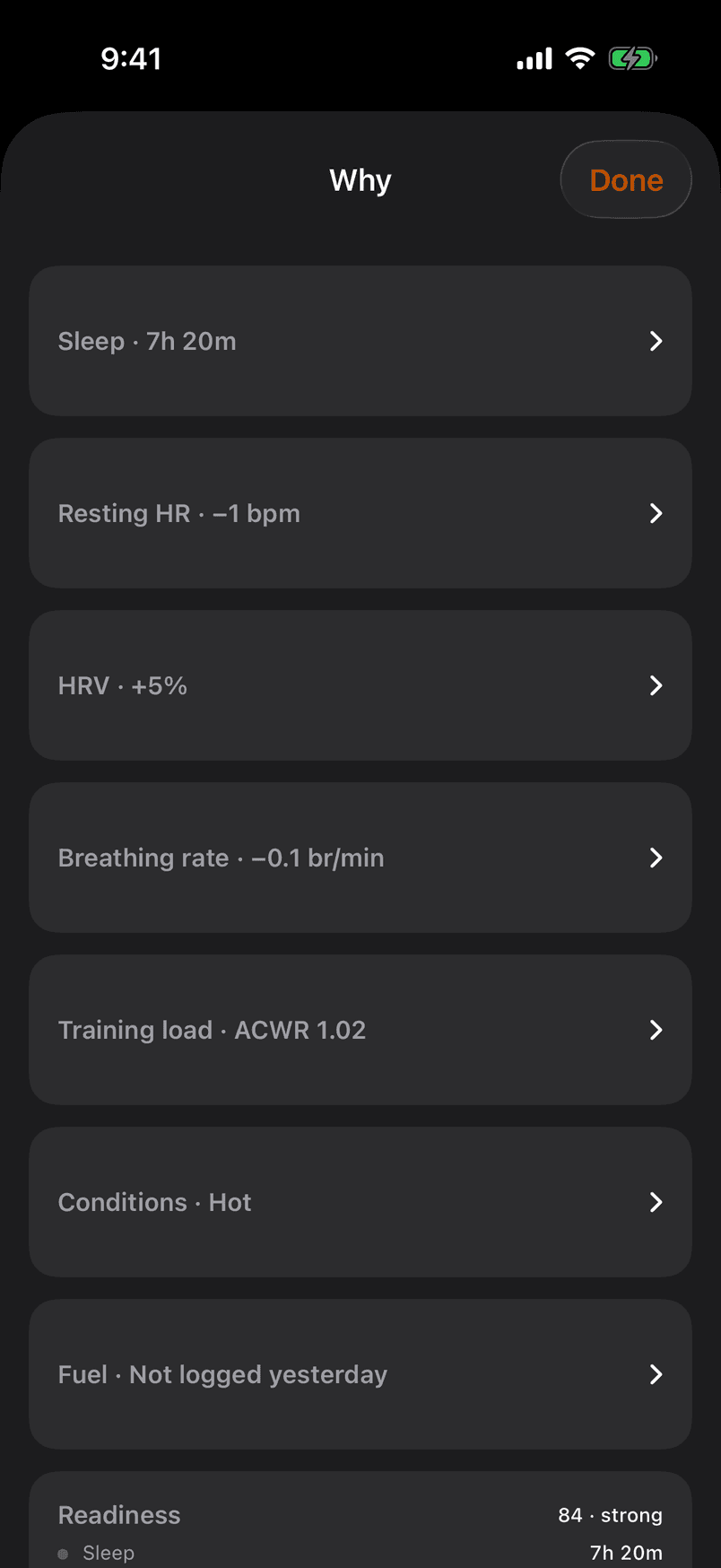
Why row: Sleep · 6h 5m
A preferred source is set aside only when another record is at least 45 minutes longer — in sleep and in the stretch of night it covers. Two devices scoring the same night disagree by minutes; a device that was off for part of it is short by an hour or more.
One source per measurement
Never an average. Never a sum.
A ring reading a 12% drop in overnight HRV and a watch reading 2% average into a morning that looks ordinary — and that drop is what the decision is looking for. So Octane reads one source per measurement per day, by a rule that is the same every morning, and tells you which one it read.
The rule, by measurement
- Sleep, HRV, resting and breathing rate: the device that was on you all night — a ring or a strap ahead of a watch, a watch ahead of a phone.
- Steps, energy and distance: the wrist worn all day.
- The session itself: the richest recording, and which one that is depends on the sport.
Which source Octane reads is a rule about what a device is for — never a verdict on which device is right.
Your own baseline
Outside your usual range — yours, not a population's.
Until Octane has enough mornings, a resting heart rate or an HRV is read against population lines, and the Why row says “vs your baseline”. Once your own 28-day baseline is trusted, the line becomes your own spread, and the row says “vs your own spread”. The same morning can read differently for two athletes, and should.
Run it as planned, with today's signals in view
Sleep sits outside your usual range; the session stands as planned.
- Sleep
- 4h 40m of a 7h 30m need
- caution
- Resting HR
- +1 bpm vs your baseline
- supports
- HRV
- −4% vs your baseline
- supports
- Training load
- In range
- supports
12 of 17 measured mornings toward a trusted baseline
Why they disagree
When two devices disagree, the reason is about the measurement.
The card shows each source's read in a status word — in range, outside range, not measured — and one fixed sentence for why they differ: which stretch of the night each saw, which reported recently, how much history each has, or that each judges against its own normal. When the data can't explain it, the card says that too.
My devices disagree about overnight recovery.
Here is how Octane read each source of overnight recovery this morning.
- Oura · measured less of the nightOutside range
- Garmin · measured more of the nightIn range
Your devices measured different parts of the night, so they are describing different stretches of it.
A difference is not a fault. Octane explains what differs, not which device to believe.
A difference is not a fault. Octane explains what differs, not which device to believe.
Combinations
Wear what you wear.
Octane takes the night from whatever measured it and the session from whatever recorded it.
Read today
- Garmin + Oura — the watch's run, the ring's night; the watch's night as well when it stays on.
- Apple Watch + Oura — through Apple Health for the run, the ring for the night.
- Garmin + Apple Watch — two recordings of one run, counted once.
- Garmin + WHOOP, Apple Watch + WHOOP — WHOOP direct, limited to ten testers until WHOOP approves the app.
- COROS and others — through Apple Health: workouts and sleep, without HRV.
One device is the ordinary case, and the whole product works on it.
FAQ
Questions, answered.
I wear two devices. Does Octane average them?
No — averaging is how a real signal disappears. Octane reads one source per measurement per day: the device worn overnight for sleep, HRV and resting rate; the one worn all day for steps and energy; the richest recording for the session. It names the one it read, and the others stay on the record. Which one it reads is a rule about what a device is for, never a verdict on which device is right.
I only have one device. Is something missing?
No. One is the ordinary case and the whole product works on it. Reading one source per measurement is what stops a second device from making things worse — it is not a reason to buy one.
How is it different from a readiness score?
A score summarises one device's view of one morning. Octane's decision is about a specific planned session: it knows tomorrow's long run is the one worth protecting, what you ate yesterday, how you said you feel, and what you've started taking. And when nothing was measured, it says that, rather than showing a number built on one input.
Doesn't Garmin already do this?
Garmin is one of the best sources Octane has. It knows your run and, if the watch stays on, your night. It doesn't know your Runna plan, your ring, what you ate, how you said you feel, or that Sunday's long run is the one worth protecting. Octane reads Garmin in that context.
Two devices. One morning.
Free to start. iPhone, iOS 18 and up.