For runners
Keep your plan. Make it smarter.
You already have a plan you like and a watch that records every run. What's missing is the read: whether this morning supports the session, what the tempo actually showed, and what it cost the next day.
Free on the App Store · 14-day Pro trial · iPhone, iOS 18+
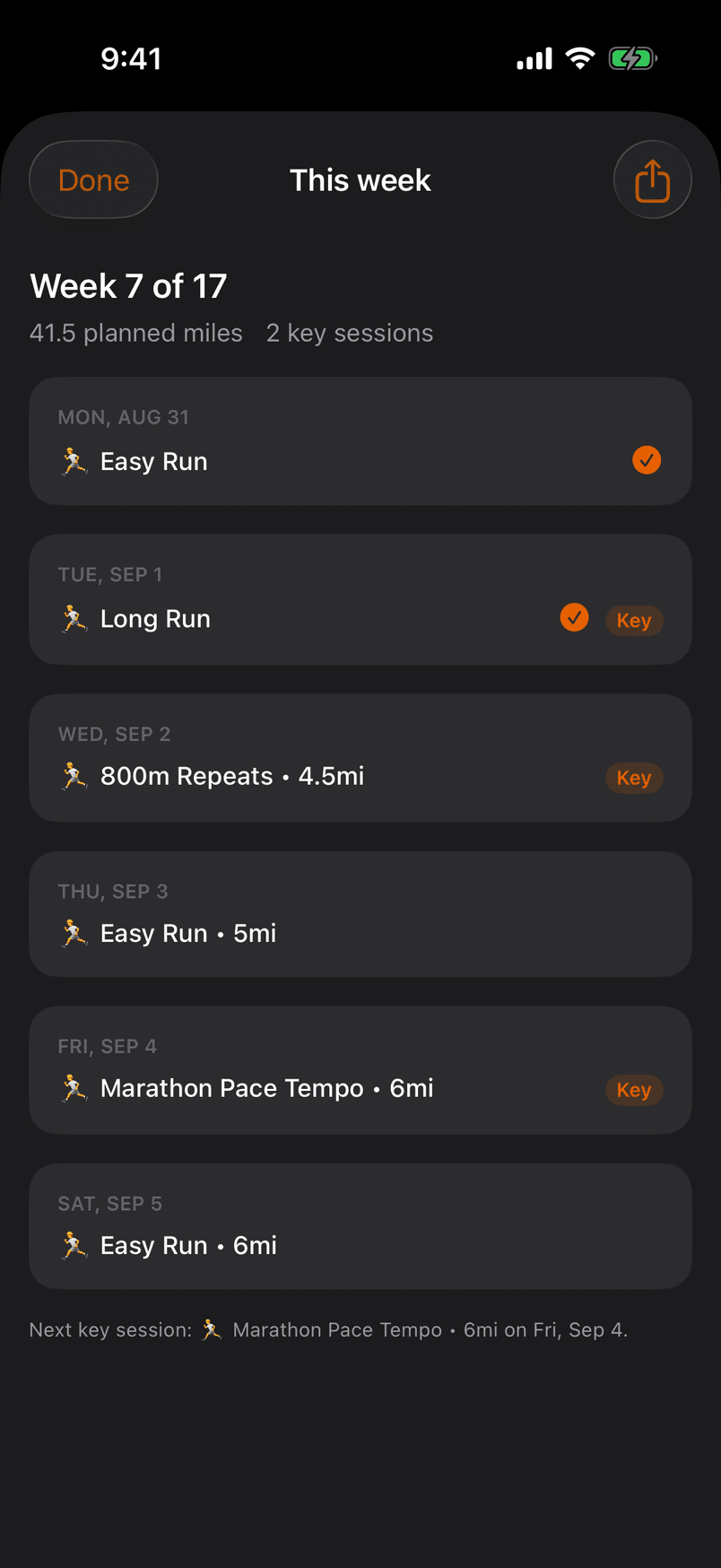
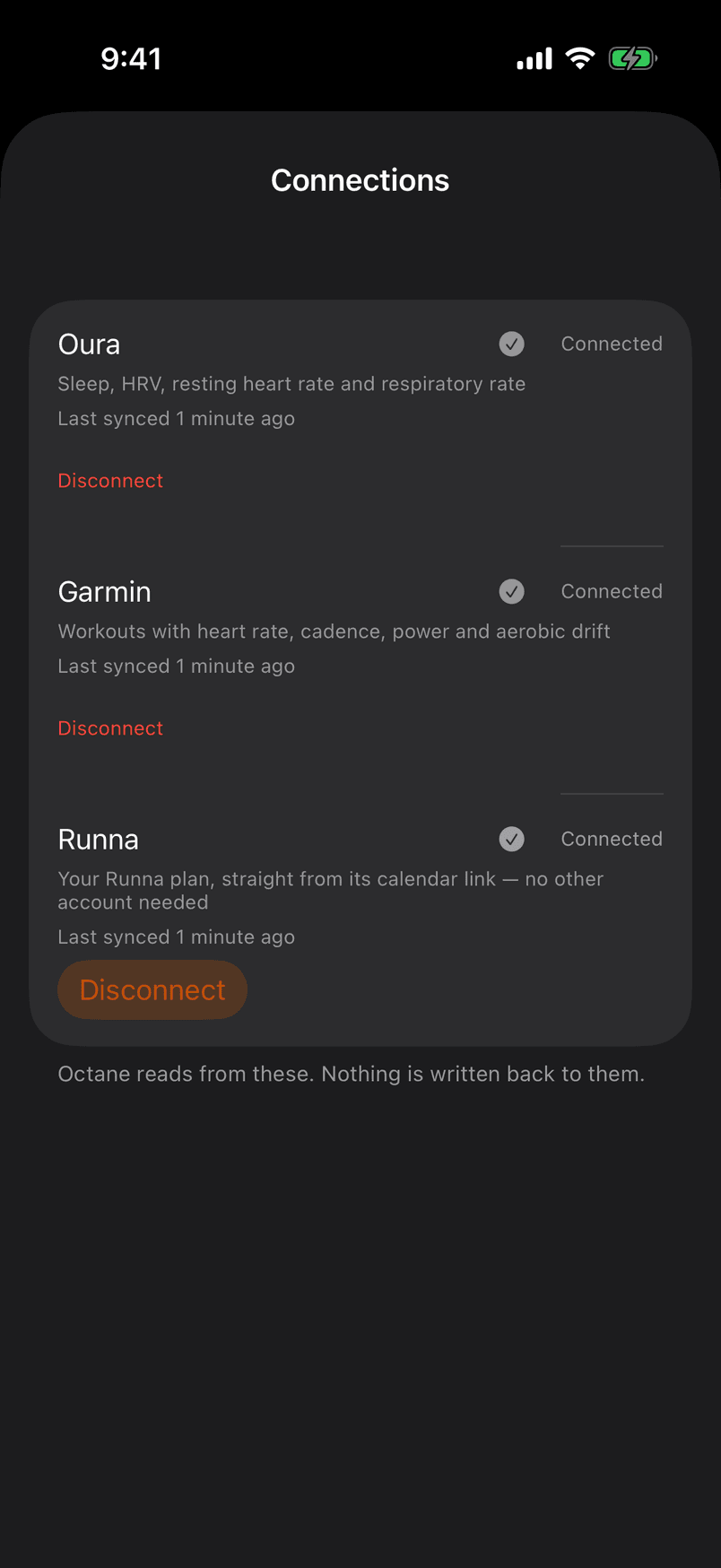
Bring your plan
Runna, or any calendar with a link.
Paste the private calendar link in the app. Octane reads every session — distance, duration, the step structure when the plan writes one — matches what you ran to what was planned, and never writes anything back.
Before you run
One decision, in one of eight words.
TRAIN AS PLANNED, PROCEED WITH CAUTION, REDUCE INTENSITY, SHORTEN, RECOVERY DAY, REST DAY, SESSION COMPLETE or NO PLAN — with the sentence naming what sat outside your usual range, and the seven rows behind it.
Run it as planned, with today's signals in view
Sleep sits outside your usual range; the session stands as planned.
- Sleep
- 4h 40m of a 7h 30m need
- caution
- Resting HR
- +1 bpm vs your baseline
- supports
- HRV
- −4% vs your baseline
- supports
- Training load
- In range
- supports
12 of 17 measured mornings toward a trusted baseline
After you run
The tempo, read over the tempo miles.
A structured run is read over its work segment, not the cool-down. Each work mile is lined up with its lap; the read says what the miles showed and the execution line says whether the plan was met.
Prescribed · warm-up 1.5 mi · tempo 3 mi @ 8:20–8:50/mi · rest 2:30 · cool-down 1 mi
Prescribed
- Warm-up1.5 mi
- Tempo3 mi @ 8:20–8:50/mi
- Rest2:30
- Cool-down1 mi
Actual, lap by lap
- 1 mi10:46 146
- 0.5 mi6:14 151
- 1 mi8:32 167
- 1 mi8:22 177
- 1 mi8:12 183
- Rest2:30 152
- 0.75 mi9:09 157
STRONG EXECUTION — ELEVATED RECOVERY COST
What happened
- Tempo miles: 8:32, 8:22, 8:12 — each faster than the last.
- Executed to plan — 97% of the planned distance.
Why
- Across the tempo miles, heart rate climbed from 167 to 183 bpm while pace moved from 8:32 to 8:12.
What changes
- Tomorrow: Tempo / intervals — one of the week's key sessions. Octane re-checks your recovery in the morning.
Fuel
Tomorrow's long run is fuelled tonight.
The Add sheet carries one line that knows tomorrow's session — “Tomorrow: Long Run • 16mi · 150 / 375 g carbs today” — and yesterday's intake is one of the seven rows behind today's decision.
Tomorrow: Long Run • 16mi · 150 / 375 g carbs today
The day before a long run of this size asks for 400–560 g of carbohydrate at your bodyweight — a band from the literature, beside your own target.
- Pre-run fuel · 46 / 70 g carbs · by 7:00
- After your session · 12 / 40 g carbs · 26 g protein
What Octane learns
Facts about you, each with the count it stands on.
Your easy-run heart rate, your weekly norm, your resting heart rate baseline, the morning after a long run — each a sentence with its floor, and a count until the floor is met.
Resting heart rate baseline
Moderate signalResting heart rate 46 bpm (45–48) — 26 mornings since Thu Aug 6.
Usual weekly volume
Emerging signal34 mi a week (24–44) — 6 weeks since Mon Jul 20.
Mornings after long runs
Emerging signal4 of 6 measured mornings after long runs were in your usual range since Sat Aug 22.
Strength-session heart rate
Emerging signalYour strength and station sessions sit at 139–158 bpm — 4 sessions with heart rate since Thu Aug 6.
FAQ
Questions, answered.
What if I already use Runna?
Keep it. Octane isn't asking you to throw away a plan that works. Paste the calendar link and Octane reads every session, matches what you ran to what was planned, and reads the morning after — without touching the plan.
What happens when I don't finish a run?
The read says so — “Stopped at 2.8 mi of a planned 4.5 mi.” — reads what you did run rather than the plan, withholds the split and fade lines a stopped run can't have, and asks why you stopped, in your words. If you were advised to shorten, it reads as the recommendation working.
What does nutrition have to do with training decisions?
Tomorrow's long run is fuelled tonight. Octane knows the session is coming, so the Add sheet carries one line — “Tomorrow: Long Run • 16mi · 249 / 375 g carbs today” — and yesterday's intake is one of the seven rows behind today's decision.
How is it different from a readiness score?
A score summarises one device's view of one morning. Octane's decision is about a specific planned session: it knows tomorrow's long run is the one worth protecting, what you ate yesterday, how you said you feel, and what you've started taking. And when nothing was measured, it says that, rather than showing a number built on one input.
Keep the plan. Add the read.
Free to start. iPhone, iOS 18 and up.