For athletes who train for more than one thing
Your training data is fragmented. Your goals aren't.
Connect your training plan, your workouts and your wearables. Octane turns them into one picture of what you're training for, how you're responding, and what should change next.
Free on the App Store · 14-day Pro trial · iPhone, iOS 18+
For runners and hybrid athletes who already have a plan and wear a watch or ring. iPhone, iOS 18 and up.
The problem
Seven apps. One athlete.
Garmin knows your run. Oura knows your night. Runna knows your plan. Your strength session knows nothing about any of them. Each one sees part of you. None of them has the context.
- Runna
- Garmin
- Oura
- Apple Health
- Nutrition
- Goals
- Workouts
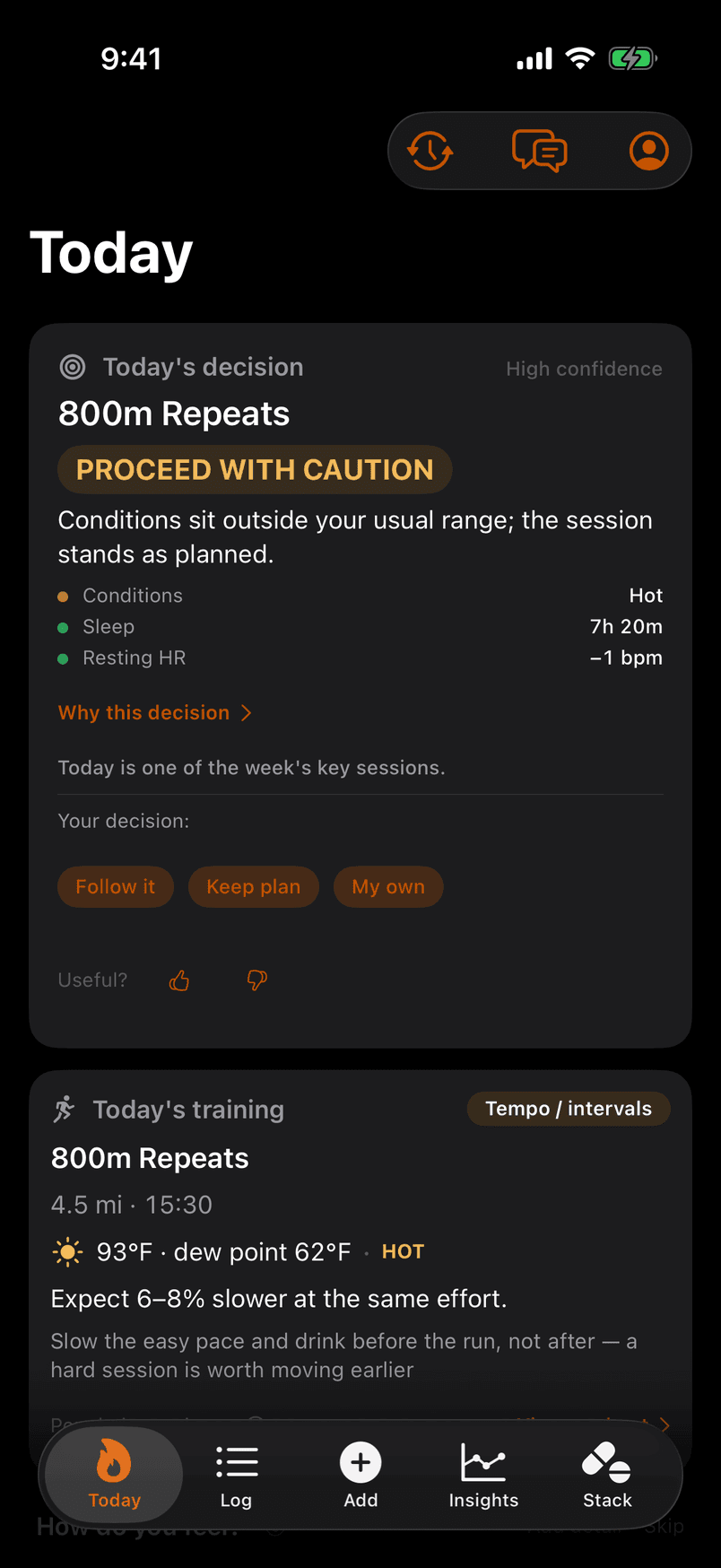
What should I do today?
Your apps have data. They don't have context.
- Running plan app
- Knows the plan.
- Wearable
- Knows its own sensors.
- Nutrition app
- Knows what you ate.
- Octane
- Reads them together, and says what changes.
Nothing is replaced and nothing is written back. Octane reads from the apps you already use.
Wearables disagree
Garmin says one thing. Oura says another.
Two devices scored the same night and disagreed by hours. Octane didn't average them and didn't pick a favourite. It read the record that saw more of the night, and said so.
One night, two records
Oura
Set asideRing — on at 4:43 am
3 h 39 min asleep
Connect
ReadGarmin watch, through Apple Health
6 h 5 min asleep
What Octane read
Connect (chosen of 3 — also Garmin, Oura)
“Oura recorded 3 h 39 min asleep against Connect's 6 h 5 min — the shorter record likely missed part of the night, so the longer one was read.”
Why row: Sleep · 6h 5m
A preferred source is set aside only when another record is at least 45 minutes longer — in sleep and in the stretch of night it covers.
Then the decision reads the night against your own baseline, never a vendor's score. The Why row says which one applied: “vs your baseline” while it forms, “vs your own spread” once it's trusted.
A difference is not a fault. Which record Octane reads is a rule about what a device saw, never a verdict on which device is right.
More than one goal
HYROX in October. Marathon in December. One athlete.
One season, several dated events. Octane knows which one comes first without forgetting the one after — and says out loud when two races sit too close to both get a taper.
The season, as the planner cut it
- Oct 24 · HYROX Miami A
- Dec 6 · CIM A
- Apr 18 · Spring half A
- HYROX MiamiHYROX specific build · Peak · Taper · Race · Recovery
- CIMCompressed by a neighbouring race.Marathon specific · Peak · Taper · Race · Recovery
What the planner says
- “HYROX Miami is 14 days after Half — planned as a B race, its row unchanged.”
- “Spring half is beyond the 182-day horizon and is listed, not planned.”
- “CIM is a B race: raced, not tapered for.”
- “Taper: sharpening, not building.”
- “Race week: short and sharp, nothing that costs.”
Pro. Already on a Runna plan? Octane reads it as before. A season is something you generate, never something that replaces your plan unasked.
The loop
Your plan should learn from you.
A plan tells you what to do. Octane reads what you did against what was prescribed, says what the session showed, and tomorrow's decision reads what it cost.
1 · Plan
What the day asks — from Runna, a coach's calendar, or a season Octane laid out.
2 · Perform
The session, as your watch recorded it — laps, heart rate, the lot.
3 · Measure
Each lap lined up against its step, each run against your own comparable runs.
4 · Compare
Prescribed against actual, in words: executed to plan, came in short, faster than the range.
5 · Adapt
Tomorrow's decision reads the morning after. Only ever the plan, or less.
A tempo, read
Prescribed · warm-up 1.5 mi · tempo 3 mi @ 8:20–8:50/mi · rest 2:30 · cool-down 1 mi
Prescribed
- Warm-up1.5 mi
- Tempo3 mi @ 8:20–8:50/mi
- Rest2:30
- Cool-down1 mi
Actual, lap by lap
- 1 mi10:46 146
- 0.5 mi6:14 151
- 1 mi8:32 167
- 1 mi8:22 177
- 1 mi8:12 183
- Rest2:30 152
- 0.75 mi9:09 157
STRONG EXECUTION — ELEVATED RECOVERY COST
What happened
- Tempo miles: 8:32, 8:22, 8:12 — each faster than the last.
- Executed to plan — 97% of the planned distance.
Why
- Across the tempo miles, heart rate climbed from 167 to 183 bpm while pace moved from 8:32 to 8:12.
What changes
- Tomorrow: Tempo / intervals — one of the week's key sessions. Octane re-checks your recovery in the morning.
Training advice only ever suggests doing less, never more.
Life changed
Life changed. Your plan should too.
Four hours of sleep, a check-in that says “off”, and a key session two days away. Octane doesn't pretend the plan is the same plan. It says what today should become, in the plan's own units.
This morning
Planned: Easy run · 5 mi
Thursday: VO2 intervals
- Sleep
- 4h 40m caution
- How you feel
- Feeling off · poor sleep caution
The decision
SHORTEN
Cut the volume today
Keep the session, shorten it. The intensity is not the problem here.
“Sleep and your check-in sit outside your usual range; today asks for less.”
- 4h 40m last night.
- You said: feeling off · poor sleep.
- Today is the cheap day to absorb this — VO2 intervals on Thu Sep 17 is the one worth protecting.
Instead
5 mi → 3.5 mi, same pace
- Run 3.5 mi instead of 5 mi, at the planned pace.
And if you'd rather move it, move it: any Octane session can be moved, skipped or restored from the plan, and a watch that receives Octane's sessions follows.
Octane never moves a session for you, never adds one, and never reads an illness into a bad night.
Station by station
Know where the race is getting away from you.
Your watch recorded one long workout. Octane reads it as eight runs and eight stations — each station against your own earlier sims, and the late runs against the early ones.
A simulation, read
Read from your watch's step markers
| Run 1 | 4:41 | |
| SkiErg | 2:30 | 30 s faster than your usual (3 sims)faster |
| Run 2 | 4:44 | |
| Sled push | 2:42 | Inside the intermediate bandinside |
| Run 3 | 4:48 | |
| Sled pull | 2:54 | Faster than the intermediate bandfaster |
| Run 4 | 4:53 | |
| Burpee broad jump | 3:06 | Faster than the intermediate bandfaster |
| Run 5 | 4:57 | |
| Row | 3:18 | Faster than the intermediate bandfaster |
| Run 6 | 5:02 | |
| Farmers carry | 3:30 | Slower than the intermediate bandslower |
| Run 7 | 5:09 | |
| Sandbag lunges | 3:42 | Faster than the intermediate bandfaster |
| Run 8 | 5:31 | |
| Wall balls | 3:54 | Faster than the intermediate bandfaster |
“Run 8 faded against runs 1–3 (+16.5%)”
8 runs 39:45 · 8 stations 25:36
Band figures are coaching practice, not a measurement.
Free: the table. Pro: the comparisons against your own sims and the run-fade line.
It never ranks a station as a weakness and never says why a split was what it was.
Your plan, your way
Bring your plan. Or build one.
Bring my plan
Already on Runna, or a coach's calendar? Connect it. Octane reads every session, matches what you ran to what was planned, and never writes anything back.
Runna · any training calendar link
How the read works →Build my Octane plan
Tell Octane your season — the events and their dates, your focus, your days, your caps, your kit — and it lays out the blocks, the weeks and the sessions. Pro.
- The events and their dates
- Running days · strength days
- Weekday and weekend caps
- Where you train, and the kit there
- Your watch, for the sessions to land on
Either way the morning decision is the same: the day as planned, or less.
One body
Your body doesn't separate these systems.
Neither should your training software. Training, recovery, fuel, water and what you take sit on one timeline, and the decision reads all of them.
Training
The plan, the session, the read.
Recovery
The night, the morning after, your own baseline.
Nutrition
Fuel windows that know tomorrow's session.
Hydration
Water against your target, a nudge only when you're behind.
Stack
What you take, on the same timeline, as medians with the confounds beside them.
Tomorrow isn't a normal day
Tomorrow: Long Run • 16mi · 150 / 375 g carbs today
The day before a long run of this size asks for 400–560 g of carbohydrate at your bodyweight — a band from the literature, beside your own target.
- Pre-run fuel · 46 / 70 g carbs · by 7:00
- After your session · 12 / 40 g carbs · 26 g protein
Why this exists
The existing stack wasn't enough. So I built the layer above it.
I run a Runna plan, wear a Garmin on the run and an Oura ring at night, and I train for more than one thing at a time — a marathon in December, hybrid work through the autumn. Each app told me something true. None of them talked to the others.
The morning after a hard session my ring said one thing, my watch said another, and my plan said the same thing it always says. Nothing read them together and told me what today should be.
Octane is that read. I'm building it with the first 500 athletes rather than for them — every recommendation has a thumbs down with a reason, and I read every one.
Free, Pro, Founding
Free collects. Pro interprets.
Free collects — connections, logging, workout numbers, the morning decision and its buttons, the check-in, the Stack log. Pro interprets — the Why, the session read, the morning after, the brief, the Stack response, the season.
Free
$0
What's included +
- Connections — Runna, Garmin, Oura, Apple Health
- The decision every morning, and the three buttons
- The morning check-in
- Smart Add — Photo, Scan, Describe, Quick add — with day-type targets
- Workout numbers
- Stack log, adherence and history
- Ten of the seventeen Insights rules
- Sharing
Everything you log and connect stays yours on the free plan.
Free
$0
- Connections — Runna, Garmin, Oura, Apple Health
- The decision every morning, and the three buttons
- The morning check-in
- Smart Add — Photo, Scan, Describe, Quick add — with day-type targets
- Workout numbers
- Stack log, adherence and history
- Ten of the seventeen Insights rules
- Sharing
Everything you log and connect stays yours on the free plan.
Octane Pro
$14.99/mo
or $99.99/yr · 14-day free trial
What's included +
- Why this decision — the seven rows behind it
- Your run, read against your own history — including the run you cut short, and why
- The morning after, against your baseline
- The morning brief, written and pushed
- Targets the engine proposes — you apply them, or don't
- Stack before-and-after, with the confounds beside it
- The GLP-1 monitor and lean-retention readouts
- Meal plans against your day-type targets
- Midday and evening check-in nudges, only when you're behind
- The season planner
- The seven Pro Insights rules
Octane Pro
$14.99/mo
or $99.99/yr · 14-day free trial
- Why this decision — the seven rows behind it
- Your run, read against your own history — including the run you cut short, and why
- The morning after, against your baseline
- The morning brief, written and pushed
- Targets the engine proposes — you apply them, or don't
- Stack before-and-after, with the confounds beside it
- The GLP-1 monitor and lean-retention readouts
- Meal plans against your day-type targets
- Midday and evening check-in nudges, only when you're behind
- The season planner
- The seven Pro Insights rules
Founding Athlete
$69.99/yr
Everything in Pro, at the founding price — locked in for as long as you stay subscribed. When the seats are gone, they're gone.
Limited to 500.
Get Octane on the App StoreFounding is bought in the app while seats remain — 14-day trial first, then the founding price for as long as you stay subscribed.
Why not…
Can't I just put my data into ChatGPT?
Can't I just put my data into ChatGPT?
You can hand a general model whatever you paste in. Octane is built around your continuously connected timeline — your goals, your plan, your workouts, your wearables, your recovery, your nutrition, and what happened after each earlier recommendation. It reads that every morning without being asked, and every number on the screen comes from a deterministic engine, not a model.
Doesn't Garmin already do this?
Garmin is one of the best sources Octane has. It knows your run and, if the watch stays on, your night. It doesn't know your Runna plan, your ring, what you ate, how you said you feel, or that Sunday's long run is the one worth protecting. Octane reads Garmin in that context.
What if I already use Runna?
Keep it. Octane isn't asking you to throw away a plan that works. Paste the calendar link and Octane reads every session, matches what you ran to what was planned, and reads the morning after — without touching the plan.
How is it different from a readiness score?
A score summarises one device's view of one morning. Octane's decision is about a specific planned session: it knows tomorrow's long run is the one worth protecting, what you ate yesterday, how you said you feel, and what you've started taking. And when nothing was measured, it says that, rather than showing a number built on one input.
Will Octane move my intervals to another day?
Not on its own. When a morning asks for less, Octane says what today's session should become — shorter, easier, or a recovery day — in the plan's own units. Moving a session is yours: any Octane session can be moved, skipped or restored from the plan, and a watch that receives Octane's sessions follows. Sessions from Runna or another plan are moved in their own app.
What's free, what's Pro, and what does it cost?
Free collects — connections, logging, workout numbers, the decision and its buttons, the check-in. Pro interprets — the Why, the session read, the morning after, the brief, the Stack response, the season — at $14.99/mo or $99.99/yr with a 14-day free trial. Founding is $69.99/yr.
The decision, its label, its sentence, the Why rows and every number on the screen come from deterministic engines reading your own data. A model writes the morning brief and reads meal photos — and any text carrying a number Octane didn't supply is rejected.
Your training data is fragmented. Your goals aren't.
Free to start. iPhone, iOS 18 and up.
Free on the App Store · 14-day Pro trial · iPhone, iOS 18+